
Would you rely on AI for car repairs? A new survey reveals surprising results

Modern vehicle issues are pushing drivers toward digital diagnostics, with AI increasingly used as a first stop before visiting a mechanic.
Car maintenance has traditionally been built on hands-on know-how, passed down between family members and friends, or found in the owner’s manual. Drivers once relied on experience, intuition, and a few basic tools to interpret warning lights or track down unusual noises. That landscape is shifting as modern vehicles become increasingly software-driven and as more drivers turn to digital systems rather than human expertise for answers.
Artificial Intelligence has made its way into nearly every corner of daily life, and it’s no longer confined to search engines and smart devices. A recent survey shows that a growing number of drivers are using AI tools to identify potential issues with their vehicles before reaching out to a mechanic. Although many users say the technology has been helpful, AI-guided repair advice is still developing and doesn’t replace professional service in many situations.

Why drivers prefer AI
Car repair costs are dramatically surging across the U.S., with up to a 15% rise over the year. Tariffs have played their part, too; imported parts are more expensive, and since modern vehicles often contain more electronics, finding a mechanic for repairs has become more difficult. Additionally, the country is facing a shortage of technicians, leading people to turn to AI alternatives.
Also, as the overall age of the car park is rising, it creates more issues for older vehicles. The car repair market can no longer withstand the pressure of repair demand, so AI has naturally begun to fill the gap.
A closer look at who’s using AI
Surveys show that the number of people turning to AI for car repairs is increasing daily, and about 56% of drivers who attempted DIY fixes turned to AI for help.
AI is becoming a versatile and reliable tool across multiple generations, especially among youngsters, who prefer contacting AI for car repairs. Roughly 49% of Gen Z, 47% of millennials, 44% of Gen X, and 30% of baby boomers have tried AI repair at least once.
Where AI helps the most with
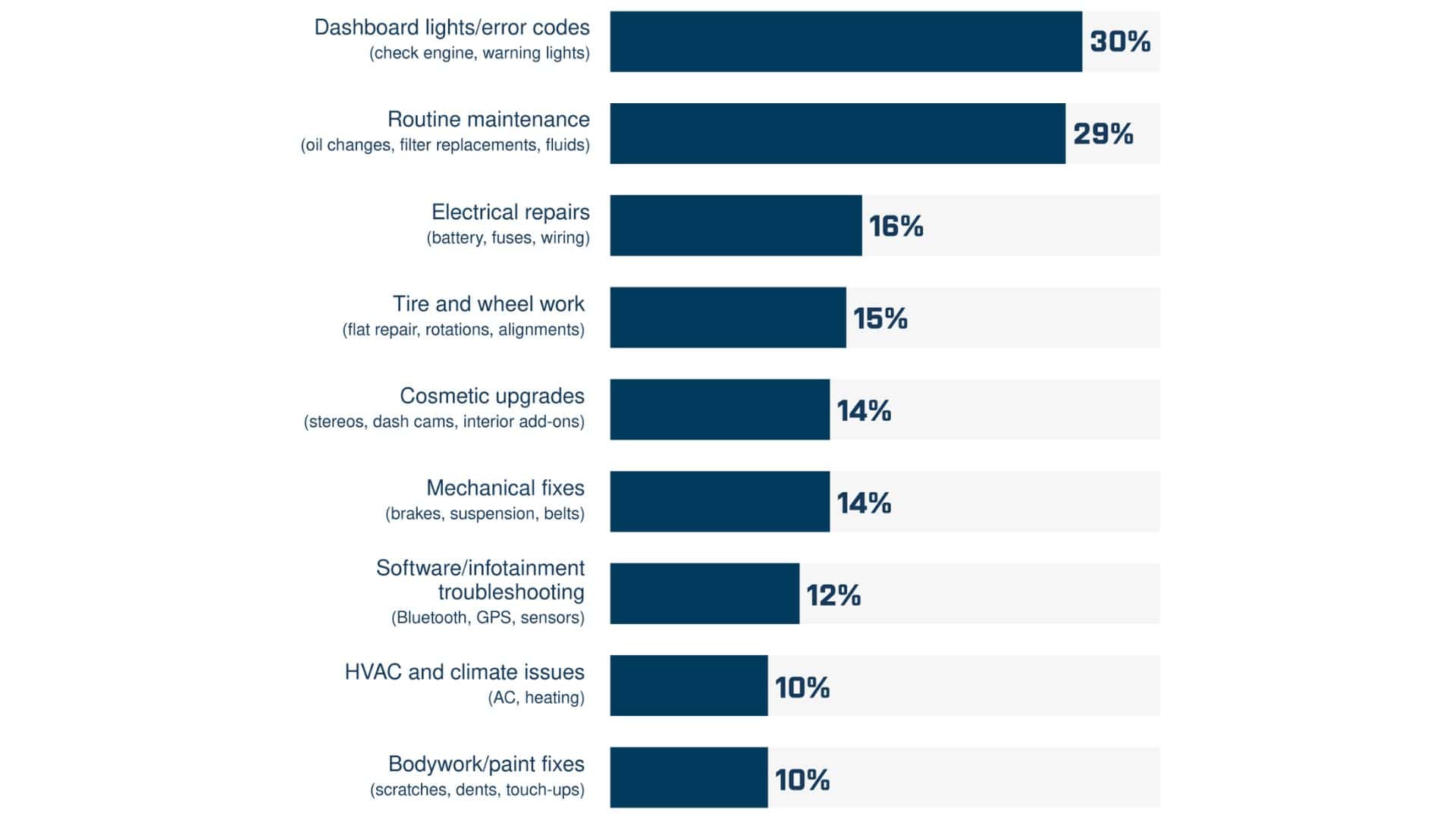
Drivers are mostly using AI to repair parts of the vehicle that cause the most confusion, like error codes and routine maintenance. About 30% of users rely on AI to decode warning lights and error messages, 29% use it for routine maintenance, and 16% inquire about electrical repairs, such as issues with the battery, wiring, or fuses. While this shows that AI assistance aligns with the user’s inquiry, it also suggests that AI typically performs best on simple tasks.
It’s easier for AI to assist with procedures that require straightforward, step-by-step guidance, simple text-based instructions, and translation of diagnostic codes. AI technology is more reliable across these categories because most solutions are standardized across car models and brands.
Where AI has limitations
The survey also suggested that mechanical repairs, such as issues with brakes and suspension systems, cosmetic upgrades, and software troubleshooting, are more challenging for AI tools to fix. Roughly 14% of users relied on AI for cosmetic and mechanical repairs, with only 12% using it for software and infotainment troubleshooting. Similarly, some AI-assisted repair attempts fail due to inaccurate assumptions or overly general suggestions that are not standardized across models.
Surprisingly, owners of electric vehicles and luxury cars experience this struggle too. According to the survey, while owners of EVs from brands like Tesla relied on AI the most, they saved the least money because AI often misinterprets their vehicle’s problems.
Is AI actually cost-effective?
One reason people use AI tools instead of contacting a mechanic is to save time and money. However, cost savings vary by brand and the complexity of the issue. American drivers who relied on AI tools for auto repairs saved an average of $115, with nearly 8% saving more than $1000. Similarly, users of luxury brands saved considerably more, with average savings of $200 for Audi, $162 for BMW, and $161 for Mercedes-Benz.
However, brands like Tesla only saved about $79 due to model-specific intricacies and technical differences. While AI is cost-effective to some extent, its efficiency depends on the specific automobile brand.
DIY experiences: A hit or miss?
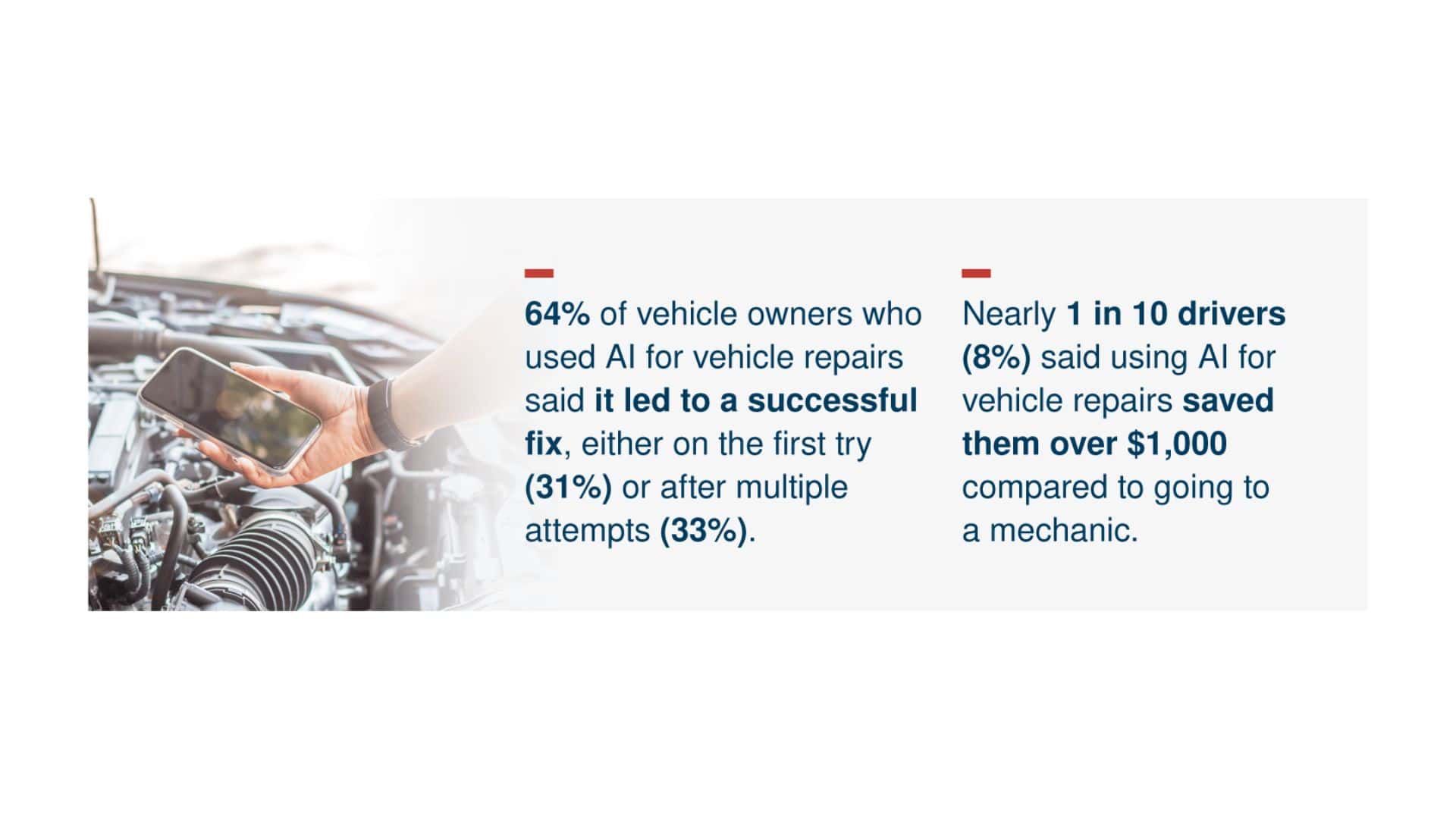
Users who reached out to AI for repair assistance have had mixed experiences. About 64% of surveyed vehicle owners had successful repairs on their first attempt, with 33% succeeding after multiple attempts. A significant portion of users had to revert to traditional troubleshooting methods, such as video tutorials, professional forums, or mechanics, because DIY repairs with AI assistance failed at some point. It shows that while AI is an excellent alternative for drivers, it can be unreliable, depending on the issue at hand.
How are people responding to AI repairs?
Social media has outlined people’s reactions to relying on AI for repairs and diagnostics. One Reddit thread discussed whether people would like to use an AI assistant to diagnose and fix cars, and they had mixed opinions.
One user mentioned, “I tried it out with this prompt (I’ve actually been having this issue) 1984 Toyota pickup. “Turbo diesel. When I floor it, there is light grey smoke from the exhaust.” I got an “unexpected server error”, tried a few times, and gave up.”
At this stage, AI doesn’t have access to every vehicle’s specific user manual and mostly relies on publicly available information. Its advantage is speed, the ability to search vast amounts of data, and the ability to summarize it in a way drivers can understand. But the technology isn’t perfect. In this case, the AI encountered a server error and couldn’t retrieve the information. For context, light gray smoke from an older engine typically indicates that coolant has entered the combustion chamber.
Another person said, “Chat GPT told me to buy fuses that don’t exist in my car.”
Car models vary a lot by year and trim, and AI doesn’t always pick up those small details. If someone wants to rely on AI for help, it’s better to cross-check the suggestion with the car’s manual or a parts diagram. That way, you can save yourself a trip to the store and avoid buying something that won’t solve the problem.
Drivers must remember that while AI is effective, it works best when the problem is simple or routine, related to codes, lights, or standard maintenance, and if the car is an older model with proper public documentation.
AI becomes unreliable when dealing with vehicles that rely on specialized tools and proprietary systems, including EV battery management software. Modern cars also rely on onboard software, so a proper diagnosis typically requires connecting the vehicle to a diagnostic tool via the OBD port.
Newer models can transmit data over the air, and in the future, AI may be able to read that information directly and identify faults instantly. If that becomes reality, drivers could receive accurate diagnostics without ever stepping into a workshop.
What this trend means for mechanics and the auto industry

While more and more people are reaching out to AI to inquire about car repairs, it’s clear that AI won’t automatically overtake the automobile repair industry. However, while AI may not handle everything, it can reshape workflows and make it easier for drivers to decide when to contact a mechanic. AI may work as an initial filter, helping drivers handle minor issues and filtering problems that can be DIY’d before recommending a mechanic. It could also reduce the number of unnecessary visits to a mechanic for trivial issues.
AI is becoming a standard tool in American garages because it addresses real concerns such as rising repair costs, complex car systems, and limited access to professional help. However, the role of AI is currently limited to weeding out trivial issues; more complex problems are far more challenging for AI to solve.