

These jobs are the most affected by AI, according to new Anthropic report

A new “AI exposure index” from Anthropic compares real-world AI usage with theoretical capability and reveals which professions may feel the impact first.
Artificial intelligence has been transforming workplaces rapidly, but measuring its real impact on jobs has proved surprisingly difficult. A new report from AI company Anthropic aims to change that. By combining data on what large language models can theoretically do with how people actually use them in professional settings, the company created an “AI exposure index” designed to estimate which occupations are most likely to be affected by automation. The results show a gap growing in a specific direction.

The report
Anthropic, an artificial intelligence research company, recently released a report introducing a new way to measure how AI may influence the labor market. The framework aims to capture the gap between what AI systems are theoretically capable of doing and how they are actually used in the real world.
The report builds on several data sources, including the O*NET occupational database, which catalogues the tasks associated with hundreds of U.S. jobs and Anthropic’s internal usage data. Researchers also incorporated earlier task-level estimates from economists that measure whether a large language model could theoretically complete a task at least twice as fast as a human.
The researchers created a score that reflects real-world adoption, giving higher weight to tasks where AI is being used for automation rather than simple assistance. The goal is to track where AI is already influencing work and identify occupations that may be more vulnerable to disruption as the technology spreads.
The jobs most exposed to AI
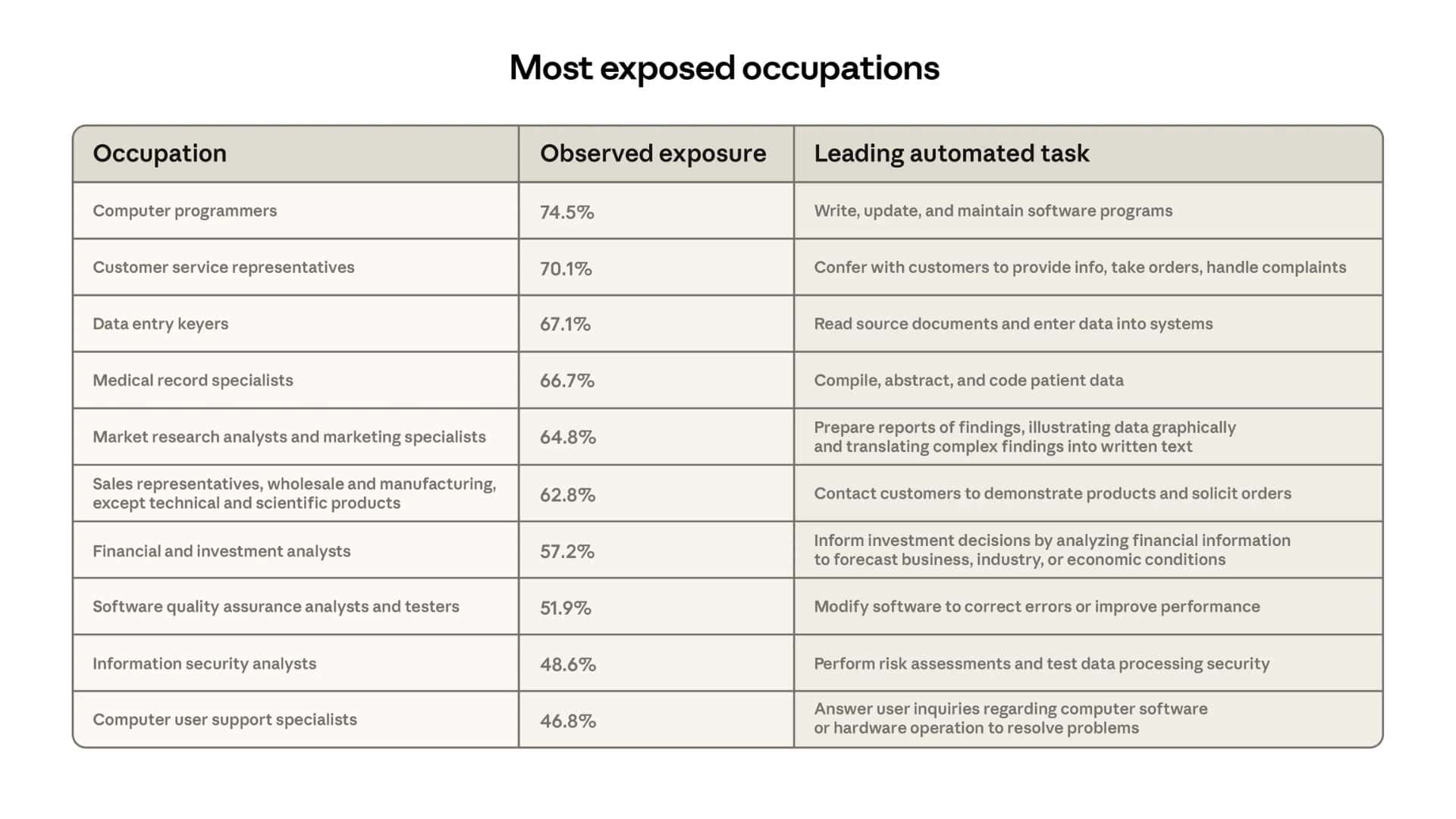
When researchers ranked occupations by observed exposure, a clear pattern emerged: knowledge-based roles dominated the top of the list.

Computer programmers ranked as the most exposed occupation, with about 75% of their job tasks covered by AI tools. Customer service representatives followed close behind, and data entry jobs also ranked highly, with about 67% of their tasks covered, largely because their work often involves tasks that language models and automation systems can increasingly handle.
Why some jobs are more vulnerable than others
Large language models excel at tasks involving text and structured digital workflows. That includes activities like writing code, summarizing documents, responding to customer inquiries, and analyzing data. But there are a lot of occupations that rely on skills that AI can’t easily replicate.
Another important factor is the gap between theoretical capability and real-world adoption. Researchers note that some tasks that AI could theoretically perform may not yet appear in usage data because of legal restrictions, workflow requirements, or the need for human verification.
According to the analysis, workers in the most exposed roles are more likely to be highly educated, higher paid, and employed in white-collar fields. They are also statistically more likely to be female and somewhat older than workers in less exposed occupations. On average, the report found that workers in the most exposed jobs earn about 47% more than those in occupations with little or no AI exposure. Graduate degrees are also far more common in these roles.
What the early data shows so far
Despite widespread speculation about AI-driven job losses, the report finds little evidence so far that AI has caused major employment disruptions. Using data from the U.S. Current Population Survey, researchers compared unemployment trends between workers in highly exposed occupations and those in jobs with little or no exposure.

Since late 2022, the unemployment rates of these groups have remained largely similar. However, the researchers did identify early signs of a subtle shift in hiring patterns. Among workers aged 22 to 25, entry into highly exposed occupations appears to have slowed. Data suggests a roughly 14% drop in the rate at which young workers start new jobs in AI-exposed fields, compared with levels seen before generative AI tools became widely available.
What the findings mean for the future
For now, there are certain skills people can learn that will always be needed. The biggest takeaway is that AI’s real-world impact appears to be developing gradually rather than suddenly. Many tasks remain beyond the reach of current systems, and widespread displacement has not yet materialized. Still, as the report circulated online, users dissected the findings.
Some commenters argued that the chart focuses too narrowly on large language models, rather than the broader wave of AI-driven automation happening across industries. One user wrote that the report is “kinda inaccurate… this is an LLM exposure chart … Transportation, production, agriculture and ‘protection’ are all being automated at rapid pace by AI too,” they argued.
But as AI tools continue to improve and adoption spreads, the researchers say tracking these early signals will be essential for understanding where the technology is heading, and which parts of the workforce may need to adapt first.