

LinkedIn’s editor-in-chief, Dan Roth, reveals the most in-demand job skills in 2026

Workplaces rarely stay the same for long. As industries evolve and technology reshapes tasks, the skills employers look for can shift just as quickly.
New insights from LinkedIn are offering a clearer picture of which skill sets are currently shaping the job market. According to the platform’s editor-in-chief, Dan Roth, a fresh look at hiring trends is revealing which abilities are rising to the top in 2026 and which ones professionals may want to pay closer attention to.
Roth joined LinkedIn in 2011 and played a key role in building its newsroom-style editorial team. Under his leadership, the platform has expanded its focus on professional news, data-driven workplace trends, and expert commentary designed to help professionals understand changes in hiring, skills, and the future of work.
The interview
In a recent interview on Today, Dan Roth discussed the most in-demand job skills heading into 2026. According to Roth, the conversation about work is shifting away from titles and toward something more portable: skills.
“There are a billion profiles on LinkedIn,” Roth explained. “We were looking at the skills people have on their profiles and then the skills of the people who got a job in the last year.” By comparing the two data sets, LinkedIn identified which abilities are helping candidates transition into new roles.
The conclusion may not surprise many professionals. Employers are increasingly hiring based on what candidates can actually do. Companies review applications, assess the needs of the position, and seek the person whose skill set most closely matches the work required. But Roth emphasized that skills offer something even more important than just landing a job.
“Skills travel with you,” he said. That idea can offer reassurance for workers navigating economic uncertainty or considering a career change. While industries shift and job titles evolve, strong foundational skills remain valuable across roles and sectors.
When it comes to the most in-demand skills, Roth noted that artificial intelligence sits at the top of the list. However, he stressed that AI isn’t just about highly technical roles. “There are two big buckets,” Roth explained. He mentioned that highly technical skills are needed to build complex AI systems, but there is also a need to implement AI, which is broader and may apply to a much wider group of workers. This involves understanding how to use AI tools effectively to help organizations work more efficiently, automate tasks, and improve productivity.
Roth also addressed a growing concern many workers share: AI replacing human jobs. Instead of eliminating the need for people, he says companies are increasingly prioritizing human-centered skills.
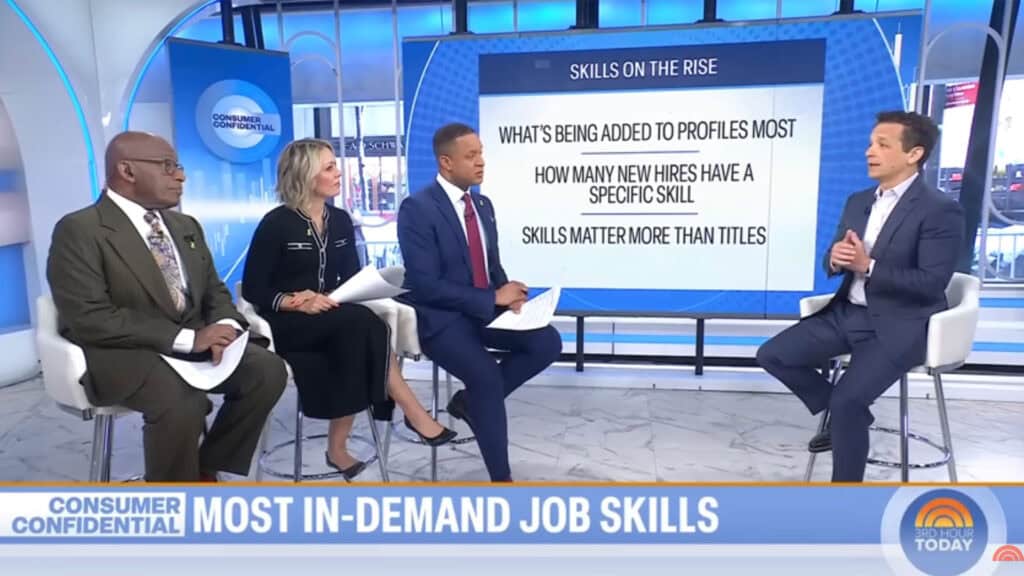
“Companies are looking for people who can adapt, who can stay agile,” Roth said. “You want teams that work well together. Those are human skills.” Leadership and people management are becoming especially valuable in this environment. Businesses still need employees who can mentor colleagues, guide teams, and help organizations navigate change.
Communication is another skill seeing significant growth in demand. Roth noted that job postings referencing storytelling skills have doubled in the past year. That includes everything from public speaking to writing emails, presentations, and reports that clearly communicate ideas. The ability to explain complex concepts in a way others understand has become a major advantage and need in many industries.
Roth’s broader message for job seekers is ultimately an encouraging one: skills are not fixed. “You can always gain new skills,” he said.
For people early in their careers, or those considering a professional shift, he recommends taking time to identify personal strengths. Talking with friends, family, and colleagues can sometimes reveal talents that may not be obvious at first. The rise of online education has also made learning new abilities easier than ever. From free courses to short certification programs, workers now have more options to build and expand their skill sets.
However, Roth noted that simply listing skills on a résumé isn’t always enough. Candidates should think about how they communicate those abilities to potential employers. Instead of presenting skills as a simple checklist, he recommends turning them into a narrative.
“When did you use them effectively?” Roth said. Sharing examples of how those abilities were applied in real situations, whether at work, in volunteer roles, or through personal projects, can help employers better understand a candidate’s value. It’s also something that can make interviews more engaging. “People want to connect with you during interviews,” Roth added.
For job seekers navigating an evolving workplace, Roth’s message is clear: technology may change the tools we use, but the ability to learn, communicate, and work well with others remains just as important as ever.

Why this matters
Conversations about the future of work often focus on layoffs or which industries are rising and falling. But understanding which skills are gaining value may be one of the most useful ways to make sense of those changes.
Data from platforms like LinkedIn offers a unique window into how the labor market is shifting. With millions of job listings and user profiles, hiring trends can reveal what companies are prioritizing long before those changes show up in broader economic reports.
That makes discussions like Roth’s important beyond a single interview. They highlight how the definition of a “qualified candidate” is evolving as technology and artificial intelligence reshape the workplace.
For those planning to change roles or simply want to stay up to date on the job market, Roth’s information is a gold mine. People can learn the right skills and build a strong knowledge or capabilities that really matter in the job market in 2026. As industries adapt to new tools and changing demands, the skills employers value most can offer an early signal of how the job market itself is transforming.