Tesla finally gets real buttons, thanks to this Norwegian startup

If you’re missing the physical buttons in your Tesla, this startup may have a solution.
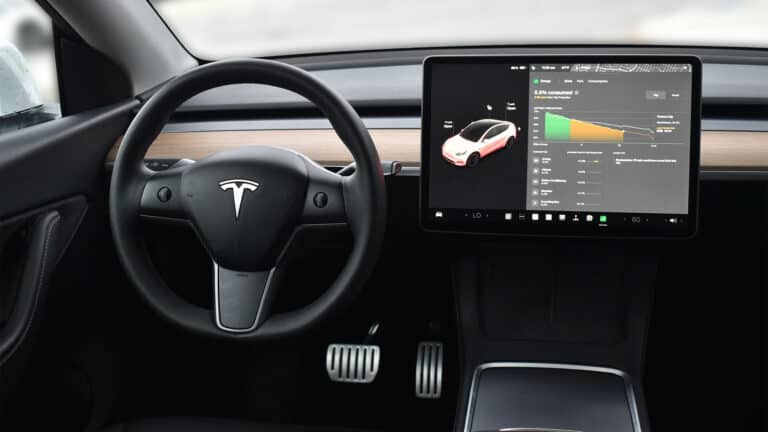
In recent years, automotive interiors, especially in premium and electric vehicles, have largely abandoned physical knobs and buttons in favour of large integrated touchscreens. New models now feature minimalist cabins, with most vehicle functions accessible only via a central display rather than physical controls. In vehicles such as the Tesla Model 3 and Model Y, nearly all settings are managed through a single large screen, but now a Norwegian startup has a solution.
Why the big screen is an issue
The move toward large, screen-dominant interiors has reshaped the modern driving experience. When Tesla introduced the original Model S with a full-size central display, it signaled a design shift that many automakers later adopted. The minimalist look and expansive screens have become a standard of premium vehicles, but they also introduce challenges that traditional buttons and knobs did not.
Unlike physical controls, touchscreens offer no tactile feedback. Adjusting the temperature or switching basic functions on and off requires drivers to look at the display, locate the correct menu, and tap the appropriate icon. In older vehicles, these tasks could be completed by feel alone, allowing drivers to keep their eyes on the road and rely on muscle memory.
Drivers are prohibited from using handheld phones, yet many vehicles now rely on even larger touch interfaces for routine tasks. The concern is distraction. Reading or sending a message typically removes a driver’s eyes from the road for about five seconds, long enough to travel the length of a football field at 55 mph without observing the road. All this functional shift leads to distracted driving. In 2023, 3,275 people died due to distracted driving in the US, and if more people look at a screen instead of the road, this number can even increase.
And while big screens still look fantastic, they are not made because the drivers like them. They are here mainly because it is cheaper to produce a single large screen and update its functionality via software than to produce individual buttons and knobs.
There is a solution
A small Norwegian startup called Greenmission is offering an aftermarket interface intended to restore the physical controls in Tesla Model 3 and Model Y.
They launched their original product, the Ctrl-Bar, in 2023, targeting owners of Tesla Model 3 and Model Y models who wanted tangible, programmable controls. The company has now introduced its next-generation system: the Ctrl-Bar 2.
What is Ctrl-Bar 2
The Ctrl-Bar 2 is described as a plug-and-play interface that adds tactile controls to the Tesla cabin. According to Greenmission’s descriptions, the system includes a bar that mounts beneath the car’s central screen, a stripe accessory for ambient lighting, and a bridge accessory for connecting to additional vehicle systems.
Each element is marketed as restoring tactile control, reducing distractions, boosting safety, and restoring natural driving.
How it works
The main component, the Ctrl-Bar 2, features two rotating knobs, eight programmable buttons (for a total of about 10 physical controls), and small displays for each button. The bar attaches to the lower edge of the infotainment screen in the Model 3 and draws power via a USB cable. Input commands are sent either via the vehicle’s Bluetooth Low Energy (BLE) system or, when paired with the Ctrl-Bridge accessory, through the car’s diagnostic (OBD) port.
Ctrl-Bar 2 can be used as a standalone product, but to use its full functionality, it is best to pair it with the Ctrl-Bridge.
Ctrl-Bridge provides additional control over functions such as door locks, climate settings, wipers, mirrors, and more.

Then the Ctrl-Stripe is an accessory that provides ambient lighting tied into the system.
All functions and button programming are handled via a companion smartphone app.
Installation
The complete system is a plug-and-play setup and does not require any workshop visit. The Ctrl-Bar installs in ~5 minutes with no tools. It attaches securely with a 3M adhesive. The Ctrl-Stripe installs in ~5 minutes with no tools, while installing the Ctrl-Bridge takes about ~5-10 minutes.
Why it matters
Ctrl-Platform aligns with the UN Sustainable Development Goal 3.6, which aims to halve global road traffic injuries and deaths by 2030.
By reintroducing tactile controls, the system seeks to reduce driver distraction and improve safety by providing a physical interface that can be operated by feel rather than by sight.
For drivers of screen-centric vehicles such as Tesla’s, the ability to swiftly and confidently actuate controls may help maintain focus on the road rather than on navigating menus.
Timeframe
The project is currently raising funding on Kickstarter, but production prototypes for pre-2024 models have already been finalized. According to Greenmission, the first units for pre-2024 models will be delivered in April 2026.
Then, for Highland & Juniper (2024+) models, the first shipments are expected in May 2026.
As vehicles become more digital, the tension between sleek design and driver safety continues to grow. Greenmission’s approach highlights a clear trend: drivers still value physical controls that support natural, distraction-free operation. Currently, it is unclear whether customer demand or regulations shape the new interior design, but screens will stay with us for a while, for sure.