

The hidden diagnostic that tells you exactly how much life is left in a used Tesla battery

A low price tag looks great until you realize the battery pack is already dying.
The booming market for pre-owned electric vehicles has made owning a Tesla more accessible than ever for the average driver. But shopping for a used EV requires a complete shift in mindset. The traditional engine and transmission are replaced by a high-voltage battery pack, and its most expensive part to replace. Understanding how to access Tesla’s internal diagnostics is the only way to uncover its true condition before you hand over your money.
Mileage is no longer the number that matters

When buying a used gasoline car, the odometer is the primary indicator of remaining life. With a pre-owned Tesla, mileage is a secondary metric that can easily mask severe component wear. Two identical vehicles with 50,000 miles on the clock can possess vastly different battery capacities depending entirely on how the previous owner treated the pack.
The range estimate displayed on the dashboard offers no protection here. That number is calculated by the car’s algorithms based on recent driving habits and temperature, meaning a degraded pack can temporarily display a flattering figure that has no connection to its actual capacity.
Heavy reliance on DC fast chargers, routinely charging to 100 percent, or leaving the battery sitting at a very low state of charge for extended periods, can degrade the internal cell chemistry far faster than gentle overnight AC charging at home. Automotive transaction data from iSeeCars reveals that the average pre-owned Tesla sells for around $31,329, yet replacing a depleted or failing battery pack out of warranty can cost between $13,000 and $20,000.
How to enter Tesla’s service mode
To determine the battery’s true condition during a pre-purchase inspection, you need to bypass the standard consumer interface and access Tesla’s hidden service menu. This is built directly into the center touchscreen and is accessible to anyone who knows the correct sequence.
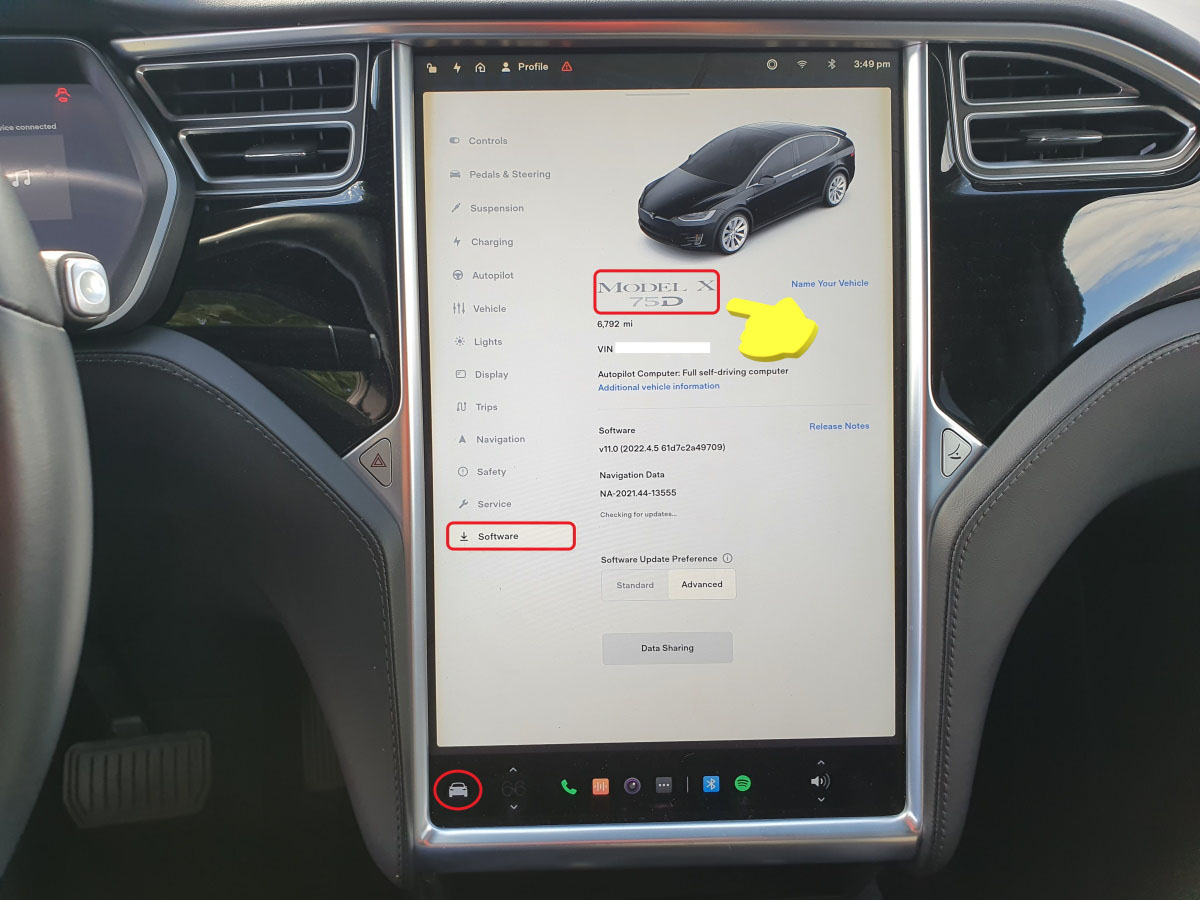
Start by navigating to the Controls menu, then tap Software. On the Software screen, press and hold the vehicle model name logo—the text that displays the model designation—for several seconds. A passcode prompt will appear on screen. Type the word “service” and confirm. The service menu will open immediately.
This gives you access to a set of diagnostic sub-menus that are not visible during normal operation. You are now looking at the same interface a Tesla technician uses during a service appointment.
Finding the Nominal Full Pack readout
Once inside the service menu, navigate to the High Voltage sub-menu. This section displays live data about the battery system. The specific value you are looking for is labeled “Nominal Full Pack,” commonly abbreviated NFP.
The NFP is not an estimate. It is the exact maximum usable energy, measured in kilowatt-hours (kWh), that the battery pack can hold right now at 100 percent state of charge. It updates in real time and reflects the pack’s true current capacity, not an average or a projection.
To calculate the battery’s state of health, you compare this live readout against the original factory capacity for that specific model. A new Model 3 Long Range, for example, leaves the factory with approximately 82 kWh of usable capacity. If the NFP on the car you are inspecting reads 72 kWh, the pack is operating at roughly 88 percent of its original capacity. That calculation takes less than two minutes and tells you more about the vehicle’s long-term value than any other check you can perform on the lot.
A pack retaining above 90 % is considered excellent. Between 80 and 90 % is acceptable for the price, provided the vehicle is priced accordingly. Anything below 80 % on a high-mileage car warrants serious caution, as further degradation is likely to continue.
Why the 24-hour battery test is not practical here
Tesla’s service menu also features a full Battery Health Test, which performs a complete discharge and recharge cycle to produce a detailed diagnostic report. This is the most thorough assessment available, but running it in a dealership setting is not realistic. The test can take 12-24h to complete and requires access to a charger. It is better suited to a situation where you have already committed to a vehicle and want a post-purchase baseline, or when a shop is conducting a pre-sale certification. On a test drive, the NFP readout is what you need.
How to use this information to negotiate

Pulling up the service menu alongside the seller completely changes the dynamic of the negotiation. Any reputable private seller or dealership confident in the vehicle’s value should have no issue allowing a two-minute diagnostic check. Resistance or outright refusal to allow it is itself useful information.
If the readout reveals an acceptable but reduced capacity, say, 83 % retention, you now have an objective number to work with. A lower NFP means reduced real-world range on every charge for as long as you own the car. That is a quantifiable disadvantage, and it justifies negotiating a meaningful reduction from the asking price to compensate. If the math reveals a battery that has degraded significantly below 80 percent, the best decision is simply to walk away and find a healthier vehicle.
Treating a used Tesla as a rolling high-voltage computer, rather than just another used car, ensures that your investment goes into an asset with real remaining value rather than an impending electronics repair bill.