
How to drive safely with a trailer— what every beginner needs to know before hitting the road
Key habits that make towing safer and more predictable in everyday conditions.
As summer approaches, more people choose to rent a caravan or a trailer and head into the wilderness or on a road trip. Many of them, however, have never pulled a trailer (or only rarely). That gap in experience shows up quickly once the vehicle is on the road and the extra weight starts to change how everything behaves.
Once a trailer or caravan is attached, the way a vehicle behaves changes immediately. Acceleration becomes slower, braking distances increase, and steering input affects both the car and the trailer behind it. For drivers who only tow occasionally, this shift can feel unfamiliar at first, but it becomes manageable once the basics of control are understood.
Driving with a trailer is about discipline: smoother inputs, earlier decisions, and constant awareness of what the trailer is doing.
Controlling speed and reading the road ahead
Speed is the single most important variable when towing. A loaded trailer does not respond well to sudden changes, and stability decreases as speed increases. In practice, it helps to think in terms of buffer space. Keeping a slightly lower speed than surrounding traffic gives you time to react without forcing abrupt braking or steering. Many experienced drivers naturally settle below highway flow when towing, not because of regulation, but because stability improves significantly. When towing, forget about overtaking everyone on the freeway. Follow trucks or slower vehicles that keep a moderate but constant speed.
Braking also changes fundamentally. A trailer increases stopping distance, sometimes by a noticeable margin depending on weight. This means that braking should begin earlier and be applied more gradually. Sudden braking can cause the trailer to push forward or destabilize the vehicle, especially on wet or uneven surfaces.
Mirrors become constant reference points rather than occasional checks. The goal is not just to monitor traffic, but to understand trailer behavior. A trailer that starts to sway slightly or drift within the lane is often the first warning that speed or wind conditions are becoming problematic. If this happens, it is better to make a quick stop and check the trailer’s weight distribution. As the following video demonstrates, too much weight at the back of the trailer can create an imbalance and cause serious accidents.
Turning, reversing, and managing trailer movement
Turning with a trailer requires wider planning. The vehicle’s rear wheels no longer define the full turning radius. The trailer follows a tighter inside path, which means cutting corners is no longer an option. Watch your mirrors carefully, and if you are not experienced, it is better to practice in an empty parking lot with cones before you head into narrow streets.
A useful mental adjustment is to delay the steering input slightly. Enter turns a bit wider and slower than you normally would, allowing the trailer to follow without clipping curbs, lane markers, or obstacles. In tight spaces, this becomes especially important, as trailers can easily swing into adjacent lanes or objects if the turn is rushed.
Reversing is where most beginners struggle. The key concept is simple but counterintuitive: the trailer moves in the opposite direction of the steering wheel, and small movements matter more than large ones. Oversteering is the most common mistake. A practical method is to place one hand at the bottom of the steering wheel and use slow, minimal adjustments. If the trailer starts to drift too far in one direction, the correction should be gentle and immediate rather than delayed. It is easier to make multiple small corrections than to recover from a large one.
Maintaining stability under load
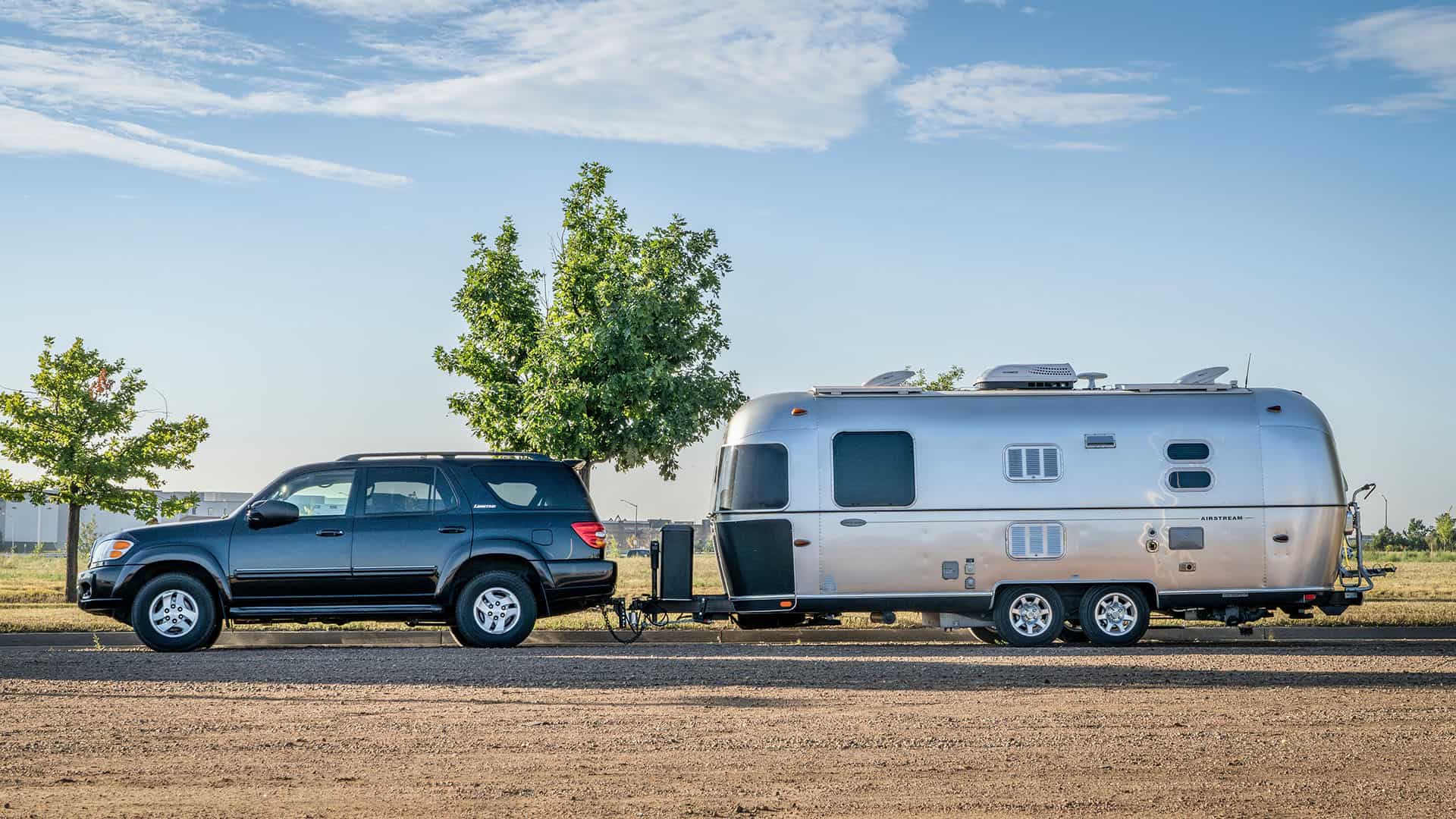
Hills introduce new challenges. Going uphill, the vehicle will naturally lose speed more quickly under load. This is where a vehicle with good torque comes in handy. Downshifting early, rather than waiting until the engine struggles, helps maintain smoother control and reduces strain on the drivetrain. On steep inclines, maintaining a steady throttle input is more effective than repeated adjustments. Try to keep the speed and momentum, and avoid sudden accelerations or movements.
Descending hills requires more restraint. Engine braking becomes useful here. Shifting into a lower gear helps control speed without relying exclusively on the brakes, which can overheat under sustained load. Shifting to 2 or L, depending on your transmission, can prevent it from shifting into higher gears and using the engine brake to slow the vehicle.
Wind also becomes more noticeable at higher elevations or open stretches. A trailer will respond more to crosswinds than a standard vehicle, sometimes requiring subtle steering corrections to stay centered in the lane. These corrections should be small and steady rather than reactive, but they can still be surprising to an inexperienced driver. As always, drive within the speed limit and avoid sudden, sharp movements.
Ultimately, towing is about reducing unpredictability. When speed is controlled, steering is deliberate, and braking is planned ahead, the trailer stops feeling separate from the vehicle and starts responding as part of a single system.