

America debuts a female crash-test dummy to address the deadly gender safety gap, finally

A new federal requirement brings female anatomy into U.S. crash-test standards for the first time.
The U.S. Department of Transportation released the design details for the first-of-its-kind advanced female crash test dummy – known as the THOR-05F. The new crash-test dummy is built to reflect a female body. The model marks the first significant update to federal safety testing in years and comes amid concerns about higher injury rates for women in inevitable crashes.
Transportation Secretary Sean P. Duffy announced the model, calling it a needed step toward improving automotive safety standards. The dummy, which carries more than 150 sensors and collects three times as many injury measurements as existing models, will now be available for manufacturers to build and use in regulatory testing once the research is complete.
The agency said the model was initially funded during the first Trump administration and finalized over the past eight months. Officials also said the THOR-05F aligns with the administration’s executive order on “Restoring Biological Truth to the Federal Government,” which directs federal agencies to use sex-specific classifications in research and data reporting.
A longstanding safety gap
Federal crash testing has long relied on the Hybrid III dummy, a model that has served as the primary tool in evaluating vehicle safety. According to the Department of Transportation, advances in technology now make it possible to better account for biological differences between male and female bodies, something the Hybrid III was not designed to capture. This limitation has contributed to higher injury rates for women than men in certain crash scenarios, prompting the development of a more accurate test device.
NHTSA classifies the THOR-05F as a 5th-percentile female dummy, meaning its size and body proportions represent a smaller female occupant. The agency used a larger percentage of female body data in its design compared with the older Hybrid III model, which relied heavily on scaled male measurements. This change is intended to provide more accurate information about how smaller female occupants experience crash forces.
The THOR-05F was created to address this gap. NHTSA describes the dummy as an advanced small female frontal crash-test model with improved response and measurement capabilities. Its shape and crash response are based on female body characteristics, allowing for better assessment of injury risk to the brain, thorax, abdomen, pelvis, and lower legs. These improvements will help reveal how seat belts, air bags, and vehicle structures perform for small female occupants, leading to safer designs and more accurate regulatory evaluations.
The NHTSA plans to release five supporting technical documents outlining the dummy’s specifications. After the rulemaking process is completed, the THOR-05F could be added to New Car Assessment Program testing and used in Federal Motor Vehicle Safety Standards evaluations.
Key improvements in the THOR-05F model
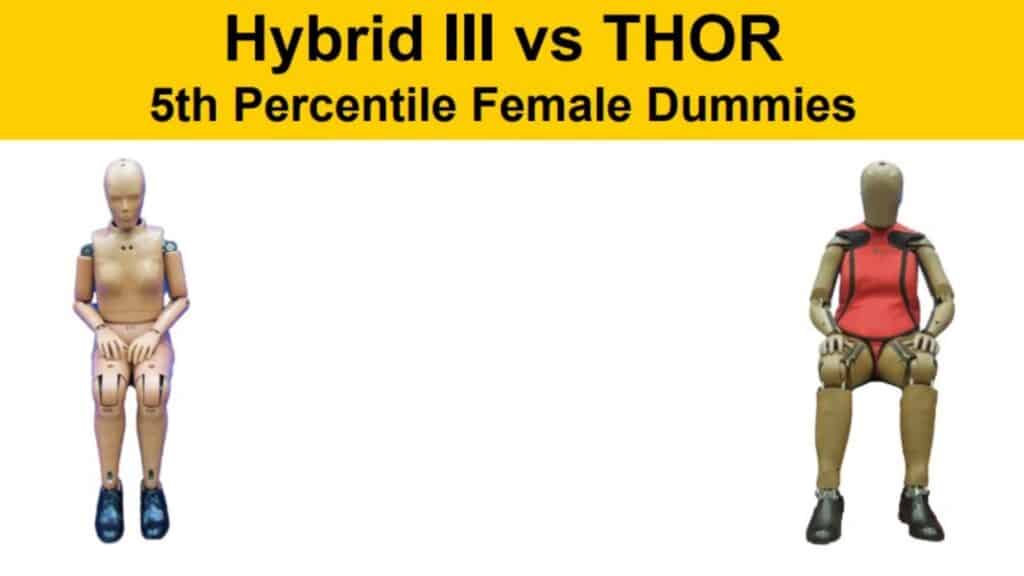
According to NHTSA documentation, the THOR-05F includes several major improvements over Hybrid III 5th, including:
- Neck bending in three directions
- A flexible spine with more natural motion
- Chest deflection measured at four points
- Pressure-sensing abdomen components
- Pelvis and hip sensors for belt and vehicle forces
- Head 6DOF rotational and translational kinematics
- Arm, leg, and ankle sensors
- Female-specific body dimensions
These updates make the THOR-05F more lifelike and allow it to record a broader range of injury data. The Department of Transportation says it collects three times as many measurements as older models, providing a clearer picture of how restraints and vehicle structures affect small female occupants.
What are people saying about it?
News of the THOR-05F drew strong reactions across online forums, including a recent Reddit thread. Most commenters welcomed the development, saying it highlights how overlooked women have been in automotive safety.
A few users pointed out that some automakers have been ahead of the federal mandate. Companies such as Volvo have already incorporated female-based testing into their internal programs. One commenter wrote, “This is part of the reason I buy Volvos for our daily drivers. They’ve been testing with female/short dummies for 30 years. They even have models for pregnant women.”
Another user added, “Companies testing with pregnant dummies is not something I ever thought about, but it is a super good thing to know to look for in the future.”
The thread also highlighted how unfamiliar many drivers were with the gender gap in safety testing. One user wrote, “I had never thought of that. What a huge oversight by the industry.” Others described the day-to-day challenges women face with basic vehicle features, including seat-belt positioning and air-bag alignment. Several said they rely on cushions or aftermarket accessories to improve their seating position.
One female driver shared, “Being a shorter female with a short back, finding a car where I won’t choke on the seatbelt in an accident is hard, even as a passenger. At this moment, I have a pillow I sit on to boost me higher. VW group cars also seem to accommodate shorter backs better than a lot of other brands.”
Many pointed out that people with higher body weight, older adults, and people who do not fit the “average male” profile remain underrepresented in testing. One user said, “We lack a lot of human body modelling in crash and safety testing. There are no anthropomorphic test devices for obese people either…there is just the 50th percentile male and the 3-year-old child….And now a female. (as defined in the Code of Federal Regulations).
They further added, “So if you fall outside those categories, automakers are modelling your physiology only at their discretion…Or when forced to by standards in other countries.”
The THOR-05F addresses part of that issue, but larger occupants, older adults, and other body proportions still fall outside the models used today. It shows how limited the current testing landscape remains, even with a new female dummy added.
The bottom line
The THOR-05F gives federal regulators a tool that more accurately reflects how female occupants experience crash forces. Its release marks a shift in U.S. safety testing after decades of relying on models built around male anatomy. As the government moves toward updating its evaluation system, the new dummy positions agencies to capture data that has been missing from standard tests and to close a gap that has affected women on the road for years.