
A woman followed her GPS straight onto a light rail track—and kept driving until she reached the next station
Everyone has a GPS horror story. Most of them don’t make the evening news.
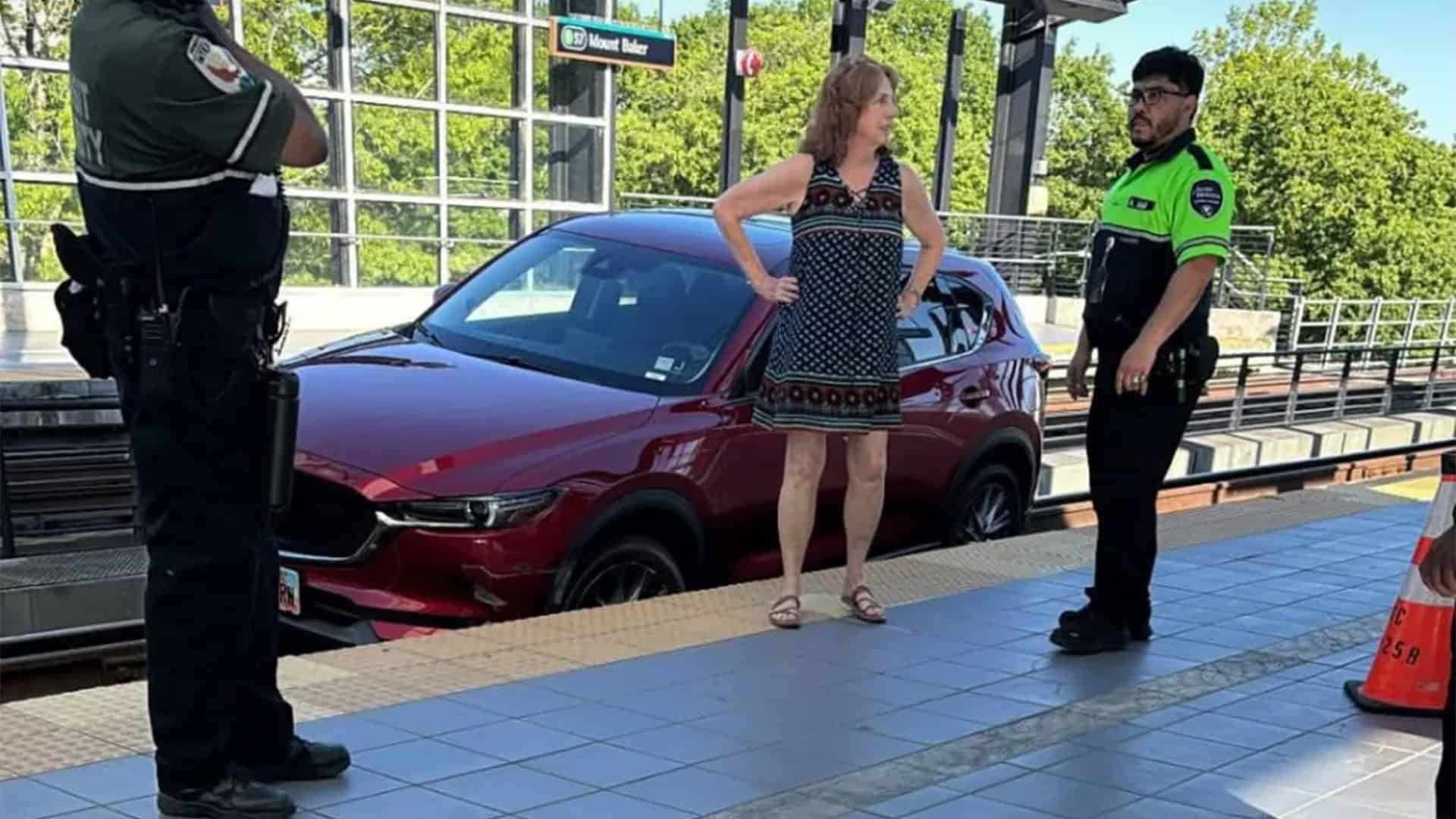
On Tuesday evening, Seattle’s 1 Line light rail service went dark for two hours. Not a mechanical failure, not a scheduling issue. A 70-year-old woman had driven her red Mazda SUV onto the elevated rail tracks near Mount Baker Station, a neighborhood southeast of downtown, and gotten it thoroughly stuck. She had, by all accounts, been following her GPS.
Footage circulating on Reddit shows the SUV coming to a stop at the station platform after traveling nearly a quarter of a mile on the railway tracks. A photo followed, capturing the driver standing beside her stranded vehicle, arms planted on her hips, looking as if she were trying to figure out who had caused all this mayhem. Emergency crews cut power to the tracks, brought in a swing loader, a specialized machine that travels along the rails, and lifted the SUV out using straps. Luckily, nobody was seriously hurt, and the driver was taken to the hospital as a precaution and, according to police, won’t face any charges.
The whole thing is easy to laugh at, and many people on the internet did exactly that. But underneath the absurdity, there’s something worth sitting with.
When GPS loses the plot
Anyone who has used navigation regularly has a story. The app confidently routed you to the back entrance of a warehouse when you wanted the front door. The recalculation sends you down a road that dead-ends at a field. We’ve all been there, and while those moments are annoying, occasionally embarrassing, but almost always harmless. Driving onto an active elevated rail track is a different category of wrong entirely, and it is hard to understand how this even happened.
GPS works from map data, and map data has limits. It doesn’t feel the surface, and it can’t see that lane markings have disappeared or that the road has narrowed to something that looks nothing like a street. The driver has all of that information available in real time. And when two roads are close enough or overlap, the GPS can make a mistake and lose track.
What makes this particular story stick is the quarter mile. The woman didn’t turn onto the tracks and immediately realize something was wrong. She drove about four city blocks before reaching the station platform. Somewhere in that distance, the ride would have felt different. Something must have told her that this is not a normal road. I don’t know the area, but I believe that at some point she must have realized she was in the wrong place, panic set in, and she just kept driving.

What to do the moment something feels off
The instinct to keep going because the GPS hasn’t recalculated, because stopping feels like admitting a mistake, and maybe the next hundred yards will make it all make sense is exactly the instinct worth overriding. A car stopped in the wrong place is almost always recoverable. A car a quarter mile down an elevated rail line is a compounding problem, and it gets worse with every additional yard.
The practical habit is simple. When a turn looks physically wrong, not unfamiliar, not inconvenient, but wrong in the way that a gravel access ramp looks nothing like a road, stop before fully committing to it. Check the surroundings for a second before the car is all the way in.
If the wrong turn has already happened, pull over as soon as it is safe to do so. Most navigation apps let you zoom out and see the broader road network around you. If the surface you’re on doesn’t show up in that view, or connects to something that clearly isn’t a street, that’s the confirmation needed to stop and reverse course. Hazards on, calm assessment, back out or call for help. At that stage the situation is still manageable in a way it won’t be thirty seconds later.
It is likely that the GPS got her onto those tracks, but only a clear decision could have gotten her off them sooner. The technology is useful enough that most people now place significant trust in it without much thought. Days like Tuesday in Seattle are a useful reminder that trust has a ceiling, and the road itself remains the primary source of information.